Fusion energy
A collaborative research team has successfully fabricated and tested additively manufactured tungsten plasma-facing tiles inside an operating tokamak, marking a notable step forward for fusion component manufacturing.
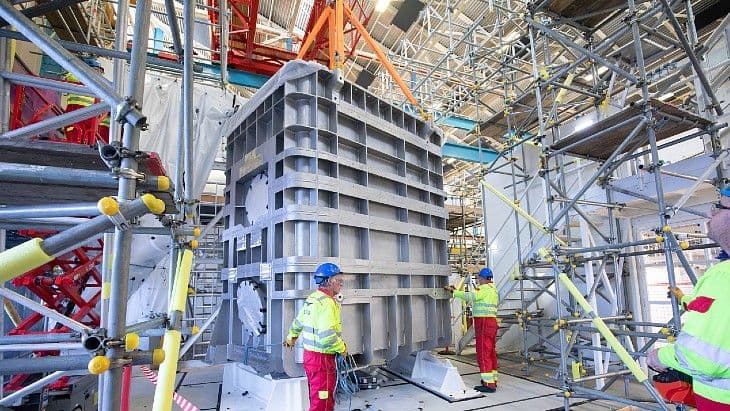
The UK Atomic Energy Authority has installed a major new heating component on its MAST Upgrade spherical tokamak at Culham, raising total heating capacity to 8.8 MW and setting the stage for higher-performance plasma experiments from 2028.
The two companies will collaborate on next-generation gyrotrons and fuel cycle technologies, supporting Germany's national Fusion Hubs initiative and Proxima's commercial stellarator roadmap.
Israel's Ministry of Energy and Infrastructure has published the country's first national fusion strategy, outlining three funding scenarios and recommending a $150–350 million National Fusion Research Center as the preferred path to building a domestic fusion supply-chain industry.
Zap Energy has met two U.S. Department of Energy (DOE) milestones for developing pulsed power capacitors essential for commercial fusion power plants. These milestones include a detailed design for a long-life capacitor and a prototype manufactured and tested in-house, demonstrating progress in both design and U.S.-based manufacturing capabilities.
Xcimer Energy has received an additional $30.5 million award from the Department of Energy's (DOE) Milestone-Based Fusion Development Program, increasing its total funding under the program to $39.5 million. This non-dilutive funding aims to advance Xcimer's laser fusion technology, integrated system performance, and commercialization readiness, with a goal of grid electricity by the mid-2030s.
The ITER Organization has received the ninth and final vacuum vessel segment, vacuum vessel sector #2, at its Cadarache site in southern France. This delivery marks the completion of major component arrivals for the core machine assembly, including the vacuum vessel, superconducting magnets, and cryostat.

Europe has delivered its fifth and final vacuum vessel sector for the International Thermonuclear Experimental Reactor (ITER) project. This component, manufactured by a consortium including Ansaldo Nucleare, Westinghouse, and Walter Tosto, marks the completion of Europe's contribution to the vacuum vessel fabrication, a process that began 16 years ago.
A bipartisan group of lawmakers in the United States has introduced legislation, the 'American Leadership in Fusion Act,' proposing a $10 billion investment to accelerate the commercialization of fusion energy and establish a dedicated Office of Fusion within the Department of Energy.

The United Kingdom is transitioning its fusion energy sector from research to industrial and commercial development, backed by significant government investment. This shift emphasizes building industrial capability, supply chains, and a skilled workforce for future commercial fusion plants, drawing lessons from the established fission industry.

Proxima, a company spun out from the Max Planck Institute for Plasma Physics, has announced plans to establish Germany's first high-temperature superconducting (HTS) tape production facility in Lower Saxony. This initiative aims to bolster European supply chain resilience for fusion energy components and other advanced technologies.
The ITER Organization has announced substantial progress in the assembly and installation phases of the international fusion project. Teams are actively engaged in multiple key activities to advance the complex endeavor.